You're Probably Already Doing Signals-Based Marketing [DIAGNOSIS]
Most revenue teams already use signals — they just use them in the most limited way possible:
- A demo request fires a confirmation email
- A trial signup starts an onboarding sequence
- A webinar registration drops the contact into a nurture campaign
These are signal-triggered actions, and they work — for exactly one step.
The problem: most systems stop there. They react to one signal at a time, in isolation, with no memory of what came before and no awareness of what's happening elsewhere in the account.
Your buyer visits the pricing page four times, invites two colleagues into the trial, and browses your API documentation — and your system still treats them like every other signup. The real opportunity is not reacting to a single signal. It's building a system that interprets signal patterns and responds with intelligence.
The Difference Between a Trigger and a Signal System [ARCHITECTURE]
Simple triggers
A trigger follows a rigid pattern: signal occurs, action fires. It answers one question: what should happen when this event occurs?
- Input:
trial_signup - Output: send onboarding email
That logic is easy to build and easy to understand — but it has a ceiling. Every trigger is an island.
Signal systems
A signals-based system answers a fundamentally different question: what does this account's behaviour mean?
Instead of mapping one event to one action, it reads clusters of behaviour and assigns context. Three stakeholders from the same account visiting the pricing page within 48 hours is not the same as one person glancing at it once. A trigger treats those identically. A signal system does not.
Example comparison:
| Trigger | Signal System | |
|---|---|---|
| Inputs | trial_signup |
Pricing page visits + multiple stakeholders active + feature exploration |
| Interpretation | None | High buying intent |
| Output | Send onboarding email | Notify AE + send pricing content + launch retargeting |
This is the shift from automation to intelligence.
Why Signals-Based Marketing Is Becoming Practical [CONTEXT]
This concept is not new — revenue teams have talked about intent-based marketing for years. What's changed is that the infrastructure finally supports it.
Three shifts made signals-based GTM systems feasible:
1. Event-based analytics matured
Tools like PostHog capture behavioural signals at scale with granularity that wasn't available five years ago. You can track not just pageviews but:
- Specific interaction patterns
- Feature adoption sequences
- Activation milestones — all as structured events
2. Composable GTM stacks replaced monolithic platforms
When your data, orchestration, and interaction layers are modular, signals can move between systems without Brittle Stitching. Reverse ETL tools like Hightouch activate warehouse data directly into execution tools, eliminating manual syncs that used to break every quarter.
3. AI interpretation replaced static scoring
Instead of writing rules like "if pricing_views > 3, mark as hot," AI models analyse signal clusters in context — inferring that an account is evaluating solutions based on the combination of research behaviour, stakeholder involvement, and timing patterns. This is what makes the system AI-native rather than rule-bound.
The Goal of Signals-Based Marketing [FRAMEWORK]
The end state: your revenue systems listen continuously for buying signals across every source — product, website, CRM, third-party intent — and respond automatically with the right action, to the right account, at the right moment.
Traditional model vs. signals-based model
Traditional: Campaign → leads → nurture → hand-raise (one direction, predetermined sequence)
Signals-based: Signals → interpretation → action (responsive, behaviour-driven)
This is not a minor optimisation. It changes the operating model of your entire GTM engine.
The Parts of a Signals-Based Marketing System [ARCHITECTURE]
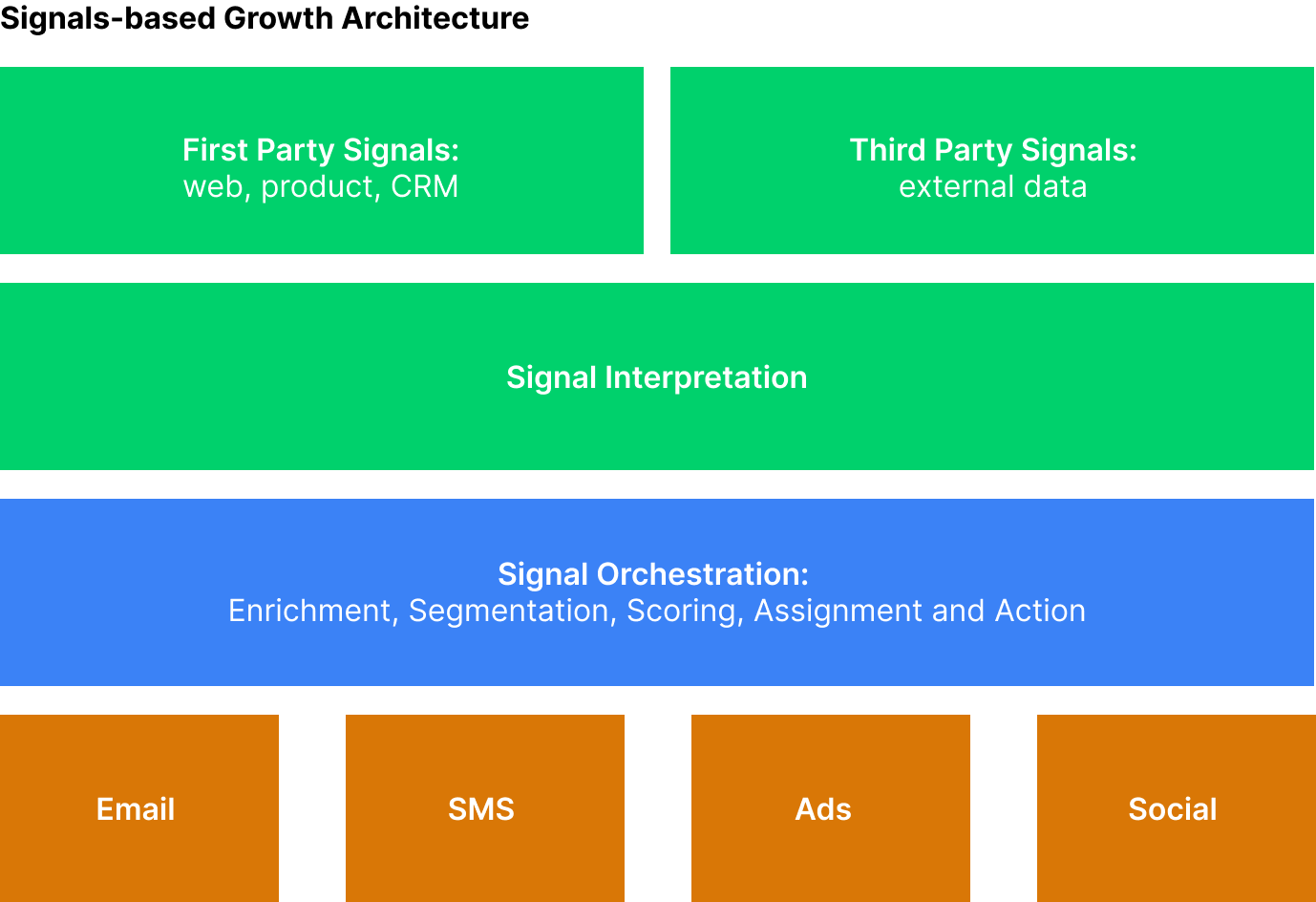
A working system has distinct layers, each with a clear responsibility:
- Signals → feed into interpretation
- Interpretation → drives audience assignment
- Audience assignment → informs decisions
- Decisions → trigger actions
Skip a layer and the system breaks — you either act on raw data without context, or build audiences without knowing what they should receive.
This maps directly to the 3-Layer Framework:
- Data Core — signal collection and unification
- Orchestration Layer — interpretation, audience assignment, and decisioning
- Interactions Layer — execution across every channel
Each layer is modular. Each layer has a defined input and output.
Signal Collection [SIGNAL_TYPES]
Signals come from three primary categories. Your system needs coverage across all of them to build a complete picture of account behaviour.
Product signals (highest fidelity)
These tell you what an account is doing with your product, not just that they showed up:
- Feature usage depth
- Workspace invitations sent
- Activation milestone completion
- Integration setups
A user who connects their CRM on day two of a trial is behaving very differently from one who logs in once and disappears.
Website signals (research and evaluation)
These indicate where an account sits in their buying process:
- Repeat visits to pricing pages
- Documentation browsing
- Comparison page views
- Case study engagement
These signals are especially valuable when correlated with product signals — someone actively using the trial who also reads your enterprise pricing page is telling you something specific.
External signals (market-level context)
These provide context your own systems cannot capture:
- Hiring patterns
- Funding announcements
- Technology adoption changes
- Third-party intent data (e.g. Bombora, G2)
An account that just raised a Series B and is hiring three RevOps engineers has different urgency than one with a stable team and no budget cycle in sight.
Signal Interpretation [ORCHESTRATION]
This is the layer most GTM stacks are missing entirely.
Without interpretation: you have raw data — pricing_views = 5, stakeholders = 3 — but no meaning.
With interpretation: those signals become actionable context — account.intent = high, account.stage = evaluation, account.fit = enterprise.
Levels of interpretation sophistication
- Rule-based — If pricing views exceed a threshold and multiple stakeholders are active, flag the account. Good starting point.
- Scoring models — Combine signal recency, frequency, and source into a composite score. Adds weight and nuance.
- AI analysis — Identifies patterns across signal clusters that static rules would miss. Most powerful, but requires clean data foundation.
Why centralised interpretation matters
When your CRM scores leads one way, your marketing automation scores them another, and your product analytics has its own activation metric, you get conflicting signals and no single source of truth — Ghost Data in action. Centralised interpretation in the Orchestration Layer eliminates this.
Audience Assignment and Orchestrated Execution [EXECUTION]
Audience assignment
Accounts and contacts are assigned to audiences dynamically — not static lists from a CSV upload. They are living segments that update as signal context changes:
- An account classified as "evaluating" today might shift to "ready to buy" tomorrow
- Your system should reassign it automatically based on new signal activity
Decisioning
Based on what segment an account occupies, the system determines what actions to take:
- Route to sales if intent is high and fit is strong
- Continue nurture if intent is moderate
- Suppress outreach if signals indicate churn risk
These decisions should be codified in your Orchestration Layer — not buried in individual tool workflows where no one can audit them.
Execution (the Interactions Layer)
Actions are the final step:
- CRM records update
- Email sequences adjust
- Sales alerts fire
- Retargeting audiences refresh
Every action traces back to a signal, through an interpretation, into a decision. Nothing fires because a calendar said it should. Everything fires because behaviour indicated it was time.
Frequently Asked Questions
Start With Your Signal Foundation
Most stacks already capture signals. The gap is almost always in interpretation and orchestration — signals exist but no system reads them together or acts on the pattern.
If your team is reacting to individual triggers while account-level context goes unread, start with a GTM Stack Audit to identify where your signal chain breaks down.